Smart India Hackathon 2025 - Winner
MoE Innovation Cell, Govt. of India · 2025
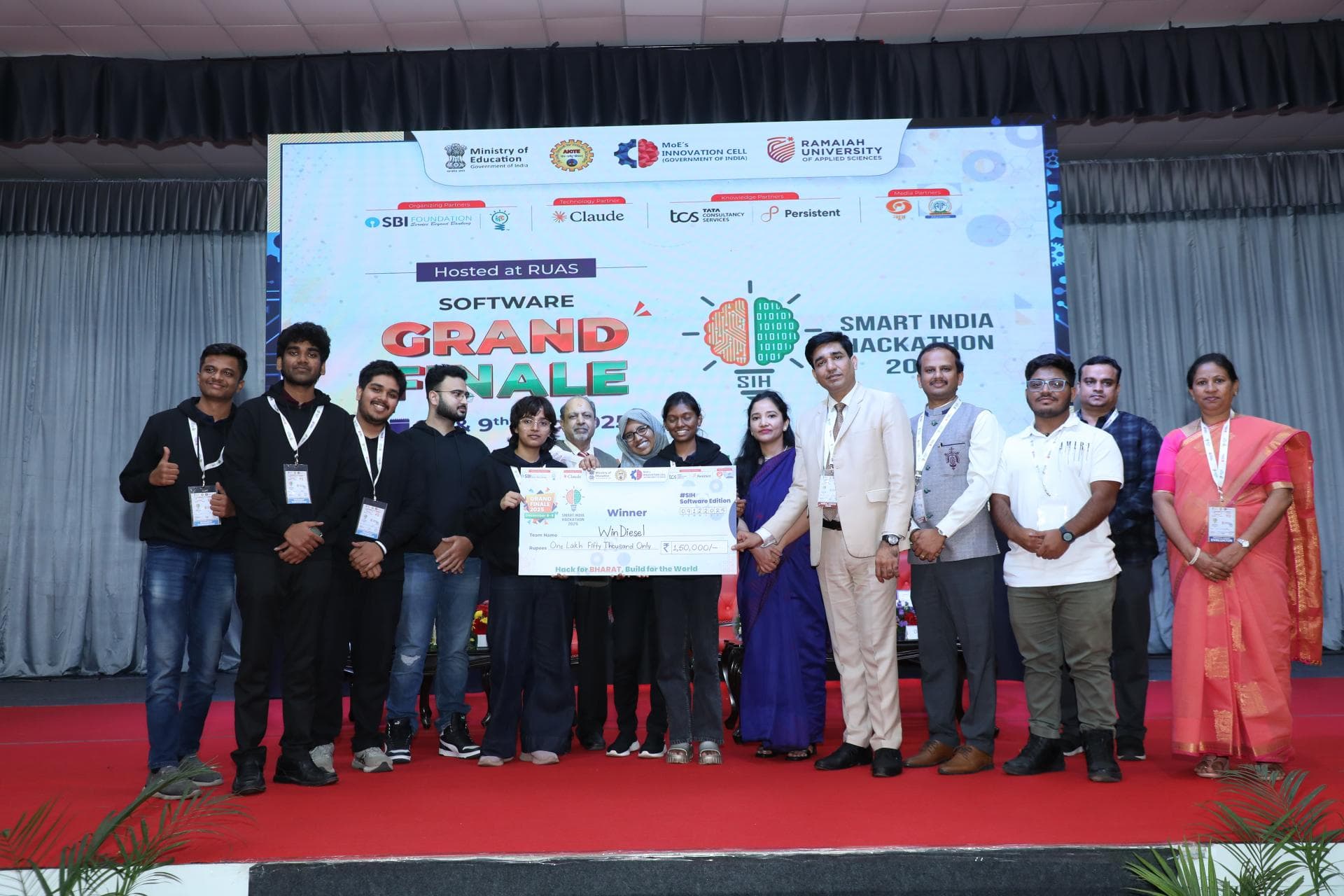
National winner of SIH 2025 (Software Edition), recognised by the Ministry of Education's Innovation Cell.
We won Smart India Hackathon 2025, Software Edition
Team Win Diesel, problem statement PS25162, Counterfeit IC Detection, put up by Bharat Electronics Limited (BEL).
Smart India Hackathon is the largest hackathon in India, run by the Ministry of Education's Innovation Cell. Problem statements come from government ministries and industry rather than invented briefs, and the teams that clear the internal and national rounds build in front of the organisation that owns the problem.
Our team: Alfiya Fatima, Yuktha P S, Ananya Gupta, Kshitij Narayan Kulkarni, Rishi Chirchi and me.
The system we built: Drishti IC
Bharath Electronics limited (BEL) screens incoming ICs on an Automated Optical Inspection (AOI) line, and a counterfeit part is often identical to a genuine one apart from what is printed on its surface manually. Drishti IC reads that marking off the AOI capture, extracts the attributes it can, and cross checks them against official datasheet metadata from manufacturers to call the part genuine or counterfeit.
My role in the build
1. OpenAPI contract, written before any code
Specced the whole inspection flow up front: endpoints, schemas, error states.
- Frontend shipped from day one, no backend to wait on
- Six people in parallel, one source of truth
- Integration near zero breakage
2. Offline by design, because BEL's machine has no internet
BEL's constraint decided the architecture: no hosted model APIs, no live datasheet lookups, verification running entirely on local models against a local metadata store.
The open problem was reference data, since a part we have never seen has no specs on the device. The decision was to queue rather than fail:
- An unresolved part number is written to the database as a pending job, and the scan still completes
- When BEL opens internet access to the device, roughly once a week, the ingestion pipeline drains that queue
- It finds the datasheet PDFs on manufacturer sites, extracts the parameters we compare on, and writes them into the local store
- The device stays air gapped all week and still gets better at recognising parts
3. Backend architecture and data layer
- Set the project structure and processing pipelines that carry an image from capture through extraction to validation
- Wired Supabase and scan history, so every verification stays auditable after the fact
How the team worked
Different domains, and none of us from an electronics background, so the first real work was research: IC markings, AOI workflows, and what BEL actually needed before any architecture got drawn. We picked the schema and the stack against team strengths rather than preference, closed the electronics to software gap with guidance from Anukul Anand, Ashutosh Pandey and several other seniors at Point Blank, and ran parallel off the contract once it was settled. All of it alongside final year and ongoing internships.
Repository: alfiyafatima09/Drishti_IC